
Emotional moment for craftsman behind King's batons as they arrive home to Glasgow
It was an emotional moment for the city when the King's batons arrived at the opening ceremony, but it was extra special for master craftsman Tim Norman who created the symbolic wooden pieces in a workshop only yards from Glasgow’s Clyde.
They were given new life from the wood of fallen trees from Glasgow’s parklands and on July 23 the King’s batons completed their journey through 74 nations to make their homecoming to Scotland for the Opening Ceremony Commonwealth Games 2026.
As the batons were reunited, it was an emotional moment not only for the city, but the master craftsman Tim Norman who created the symbolic pieces in a workshop only yards from Glasgow’s Clyde.
Their 500-day journeys began at Buckingham Palace on Commonwealth Day, March 10, 2025, when the King placed his message into the Scotland baton which he read at the opening ceremony at Glasgow’s Hydro to declare the Games’ open.
Separate batons were sent to all 74 participating Commonwealth nations and territories, allowing them to decorate and customise the historic pieces to reflect their nation’s identity.
Norman said he felt a little piece of his own Scottish heritage was traveling with each country’s individual relays.
The fourth generation wood craftsman said: “When I saw photos of different commonwealth nations putting their own designs on the batons that was so powerful for me.
“Seeing the batons in different countries made me choke up.”
His favourite memory was the imagery from the baton being celebrated in New Zealand with the rousing indigenous Māori ceremonial dance of the Haka.
“It was like a cultural blessing and I felt so privileged and connected and proud that my family heritage was in a way part of that.”
Before the Commonwealth Games were even founded in 1930 Norman’s forebears were crafting beauty from wood.
His great grandfather was a cabinet maker in the south side of Glasgow and his grandfather founded a saw mill outside Crieff where Tom’s father began his career.
It was as a toddler that Norman found the calling which has brought him the honour of designing and making the batons.
He said: “I remember being up at my Granda’s sawmill and standing in a diesel, muddy puddle in my wellies and my duffle coat and the smell of the pine resin just hit me and hardwired into my brain.”
Tim joined the family timber yard which was then in Renfrewshire and was seduced by wood while making orders up for joiners.
“The way the light refracted off the surface of the wood just grabbed me and I thought it was just an absolutely beautiful tactile material.”
He left the yard to study graphic design and in 2000 joined the Borders Woodschool near Jedburgh, co-founded by the renowned sculptor and furniture maker Tim Stead, famed for the Millennium Clock Tower in Edinburgh’s Museum of Scotland as well as a chair for the Pope's visit to Scotland in 1981.
It was at the collective that Tim learned to repurpose wood from estates’ fallen and harvested trees deemed too low grade for the commercial market that would otherwise be left to rot.
“Giving trees another life is such an nice thing to do for such old giants and for them to be part of such a historical object as the baton is beautiful," he said.
The sustainable model used in the baton follows the ethos Tim had learned from his father David, an environmental campaigner and timber importer who travelled to personally verify any wood he bought was responsibly sourced.
“He travelled to places like South America, Borneo and Malaysia. As a kid I used ti think he was like Indiana Jones in pictures of him in the jungle with these huge water Lillies and massive trees.”
In the early nineties his father alongside naturalist Dr David Bellamy visited the then Prince, Charles to consult on saving the rainforests.
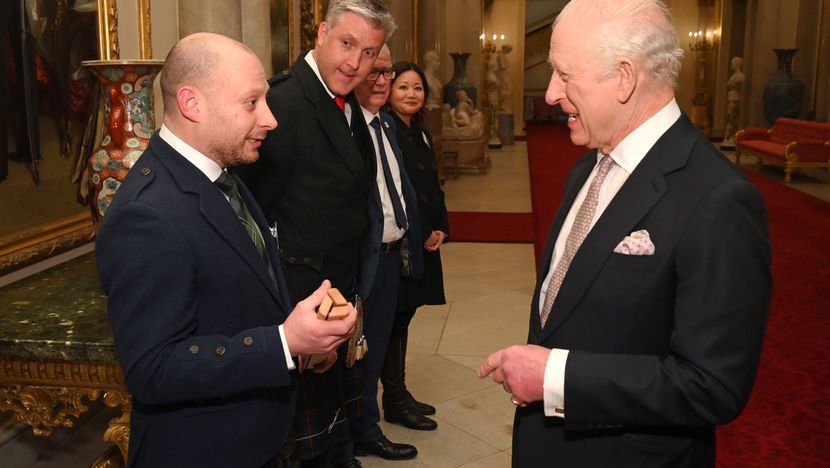
Given his father’s history with Charles it was particularly moving for Tim when he was asked to meet the King during the baton’s official unveiling and launch at Buckingham Palace.
In exchange for a workshop space Tim volunteers at social enterprise, GalGael in Govan where the batons were made.
The community enterprise situated near the River Clyde works with recovering drug addicts and alcoholics, people suffering from mental-health problems and the long-term unemployed.
When he was approached by Commonwealth organisers about the project it was so top secret he was told his designs were for “awards” to be given at the Games.
When the truth was finally revealed he was gobsmacked.
“I couldn’t believe it. It was a proud moment. One of the hardest parts was keeping it a secret from everyone.”
His design reflects the three core values of the Commonwealth - dignity, equality and humanity.
He said: "I focused on three elements, like an equilateral triangle. I played about with the timbers. It doesn’t always work this way but the magic happened and the baton was created from my original ideas.”
He is delighted that the baton reflects not only Scotland but his home city of Glasgow and that it will be a symbolic centrepiece of the Games.
“It is important that Glasgow is represented and it’s great that we are hosting the Games. I think sustainability and honouring the trees that made the batons is crucial. It is so important to me.
"I feel that’s caring about the sustainability is the responsibility of anyone who picks up a chisel.”
