
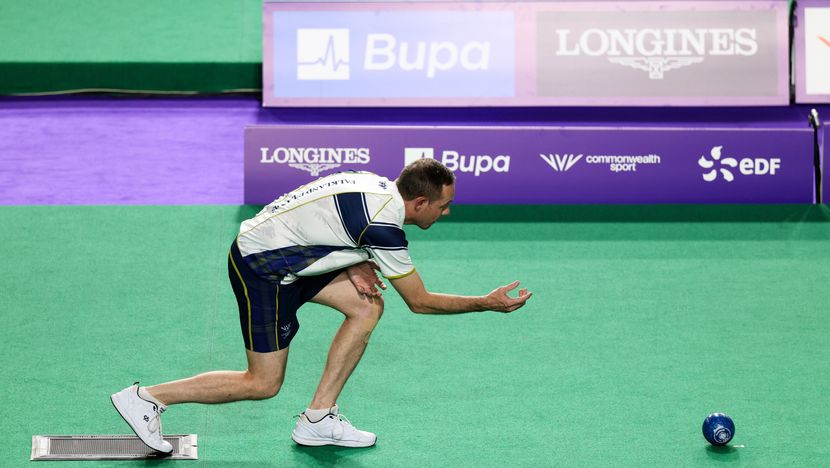
Practice in school corridor equips Falkland Island bowlers for indoor switch
The Falkland Islands' six-strong team were forced to adopt a 'do it yourself' approach to prepare for Bowls at Glasgow 2026 in response to the competition's move indoors.
The shift for one of the Commonwealth Games' longest-standing sports from natural grass to a synthetic carpet surface in an enclosed arena has transformed how bowlers approach matches.
Rinks are significantly faster than on traditional turf and elite competitors heavily favour bowls with a narrower bias to create a more direct and tightly controlled line to the jack.
The switch posed few issues in nations such as Australia, England and Scotland, where indoor bowls is an established format of the sport and the teams boast multiple indoor world champions.
But the Falkland Islanders, lacking dedicated facilities, needed to resort to creative solutions to adapt.
Cecil Alexander, of the Men's team, explained how the local bowling club created a practice rink by sticking mat carpets together in the corridor of a school building.
“This school corridor is about four metres wide and there’s quite a bit of space," Alexander (pictured) said. "We have stacked two short track carpets together and two lengthways, a little bit of duct tape over the joints and yeah, we make do.
"Unfortunately the floor leans a little to one side, so you can really only play on one side with narrow bowls, but we make do with what we have.
"It's where we started, humble beginnings, and we look forward to the future.”
Building friendships
Introducing the team who will be representing the Falkland Islands in bowls at the @Glasgow_2026 Commonwealth Games. #Falklands #TeamFalklands #Glasgow2026 🇫🇰🏴 pic.twitter.com/2JzXe9j1JJ
— FIG Representative to the UK and Europe (@FalklandsRepUK) July 22, 2026
Competing for the remote South Atlantic islands brings other challenges and the team endured a lengthy expedition just to get to Scotland for the Games.
“Flying out of the Falklands, there's two options,” Alexander said. “One is the military flight to the UK which in total is about a 24-hour journey.
"You land outside of Oxford, so you still have to make your way up here. The other way is through Chile.
"Most of us came a week or so in advance to acclimatise and make use of better facilities. It's quite a long journey, but we made it.”
Alexander took leave from his job to compete at the Games and will miss the Closing Ceremony so he can get back to work. He wouldn’t have missed the trip for the world, though.
“For me, it's not just about competing. The social part of it and building friendships is very important," he said.
“The weight of the Falklands is on the bowlers' shoulders (but) in our hotel there are athletes from different countries and different sports. “It's always nice to have some discussions and talk a little bit about where we're from and what we do. I’ve really enjoyed the experience.”
