
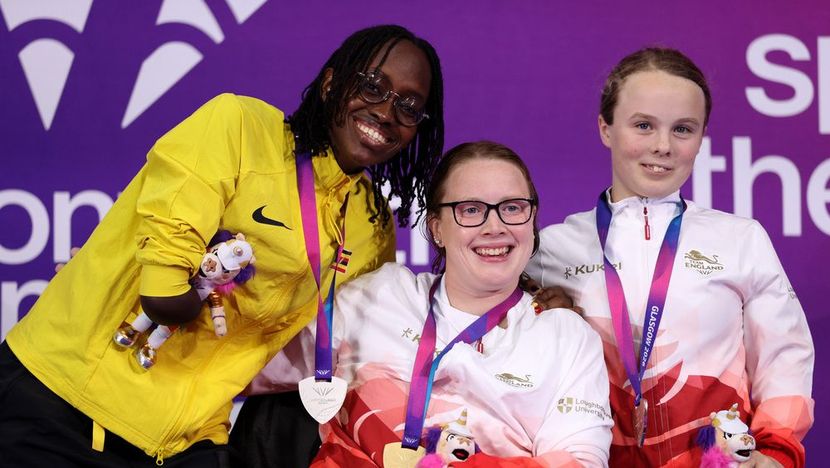
Inspired Whiston and rampant Clareburt interrupt Aussie dominance in the pool
Seven gold medals, including two more podium sweeps, ensured that once again it was Australia’s night on Monday in Glasgow’s Tollcross International Swimming Centre. But amidst this deluge of green-and-gold, two swimmers defied the tide.
First up, Brock Whiston dug deep to triumph in a thrilling Women’s 100m Breaststroke SB8 final, giving England fans plenty to shout about despite Adam Ramsay-Peaty falling short in his bid to retain the Men’s 50m Breaststroke title he won at Birmingham 2022.
Then, out of nowhere New Zealander Lewis Clareburt recovered from a huge halfway deficit to somehow wrestle the Men’s 200m Butterfly title from Trans-Tasman rival Harrison Turner.
Both performances deservedly stole the spotlight, if only briefly, from the all-conquering Australians.
‘This one means more’ says Whiston
Racing in front of her father for the first time in 17 years, Paris 2024 Paralympic champion Whiston was inspired from the gun.
Known for her strength, the 29-year-old pulled away from a high-class field to triumph in a Commonwealth Games record of one minute 22.05 seconds.
With a jubilant Husnah Kukundakwe landing silver, a first ever Commonwealth Games swimming medal for Uganda, and England’s Iona Winnifrifth, at 15, becoming Glasgow 2026’s youngest medallist so far, it was quite a race.
History in the pool 🏊
— Glasgow 2026 (@Glasgow_2026) July 27, 2026
Husnah Kukundakwe wins a first-ever Swimming and Para-sport medal for Uganda 🇺🇬 pic.twitter.com/HiYgEYhmBT
For the winner, there was only one face in the crowd she was seeking.
“This one means more,” Whiston said. “(My Dad) has never been to a major champs, so this definitely means more to me personally, than the others.
“He looked a bit emotional and didn’t say much.”
The emotions were running high everywhere.
“It's definitely going to bring huge change,” Kukundakwe said of her silver medal, also a first of these Games for Uganda in any sport.
“I'm really passionate about creating change, and I'm looking forward to seeing the impact this medal can have.”
Rounding it all off came an athlete who has now completed a Commonwealth Games, Paralympic and world medal collection while barely a teenager.
“To be able to say I've achieved all that at 15 years old, before I've even done my GCSEs (high school exams), is pretty special,” Winnifrith said.
While that Women’s 100m Breaststroke SB8 race was the only time all night an Australian did not end on the podium, it was very nearly the only race the Aussies failed to win.
For three-quarters of the Men’s 200m Butterfly there seemed no doubt that fastest qualifier Turner would triumph, with ease.
Defending champion Clareburt is famed for his finishing power, but languishing back in fifth with little more than 50m left, the challenge looked beyond even him. But, cheered on by his baby nephew in the crowd, the Kiwi found his rocket fuel.
Williamson denies Ramsay-Peaty again
"Nothing really makes sense this week".
— BBC Sport (@BBCSport) July 27, 2026
Adam Ramsay-Peaty reflects on another bronze medal at the Commonwealth Games. He came third in the 50m breaststroke, after also finishing third in the 100m. pic.twitter.com/O0Gzu8xluJ
Much of the pre-session attention had focused on the Men’s 50m Breaststroke final, and it did not disappoint.
Fresh from his 100m triumph, Australia’s Sam Williamson proved he is now the swimmer to watch in this division. The man whose spot on the throne he snatched - Ramsay-Peaty - tried his best to rally, entering the arena beating his chest and urging the crowd to roar their approval.
But once they hit the water, it was South Africa’s Michael Houlie who put up the fiercest fight.
Even a halfway deficit could not stop Williamson, while to Ramsay-Peaty’s credit he held strong for his second bronze of the Games.
Williamson’s triumph was part of a familiar parade of brilliance from those competing in yellow caps.
Like her compatriot, Alex Perkins completed the sprint double, dominating the Women’s 100m Butterfly, while Meg Harris led home a 1-2-3 in the Women’s 100m Freestyle, a feat Sam Short repeated in the Men’s 800 Freestyle.
Beau Matthews, known as ‘Running Man’, was far too quick in the Men’s 100m Breaststroke SB9 and Australia’s Women’s 4x 200m Freestyle relay quartet were far too good for the best of the rest.
It had all started with Jenna Forrester adding the Women’s 400m Individual Medley gold to the 200m Backstroke title she won earlier in the week.
Although, perhaps in a sign of hope for the rest, England’s 16-year-old rising star Amalie Smith pushed her all the way.
