
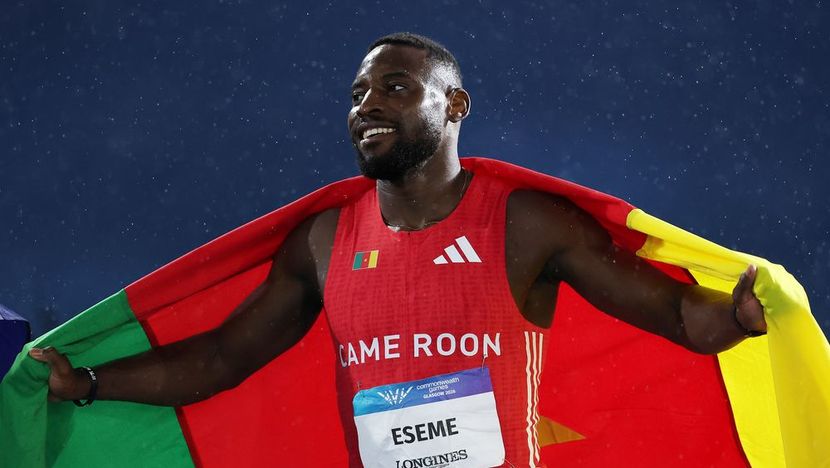
Cameroon's Eseme and New Zealander Hobbs the 100m king and queen
Emmanuel Eseme, of Cameroon, and New Zealand's Zoe Hobbs defied the rain to take gold in the blue-riband sprint event, while Australia enjoyed double gold thanks to Ky Robinson and Eleanor Patterson.
Eseme had qualified fastest for the Men’s Sprint Final in a lifetime best of 9.89 seconds and in the final improved that by 0.6 seconds for a Games record of 9.83 as he held off the challenge of Australia's Lachlan Kennedy and Kayinsola Ajayi, of Nigeria, for his nation’s first medal of Glasgow 2026.
“It’s like the hard work has paid off,” Eseme said. “I worked so hard for this and to be able to reap from all the work I'm doing, I just say thanks to god and my team and I’m very happy.
“After the semi-final, I just said to myself, 'You may not be the best starter. They may let you go in the first 50 metres, but just keep it, don't rush anything and just execute your race'.
“Somehow at the end I know I'm going to catch them.”
Hobbs was in shock at the end of the women’s race after winning in a personal best and Oceania record 10.93, ahead of England's Amy Hunt and Torri Lewis of Australia.
“This is the stuff of dreams,” the 28-year-old said.
“I’ve chipped away for so many years now with my team, so to be walking away with any colour of medal, let alone a gold, is just incredible.
“Qualifying for this event was so much harder for us than qualifying for the Olympics.
“I was in disbelief at the end. I needed to see the result on the board to have it solidified in my mind."
Robinson deals with tough conditions for gold
Robinson landed the Men’s 10,000m title - following in the footsteps of teammate Rose Davies who won the Women’s title on Monday - in a rough race during which Uganda's Samuel Simba Cherop lost a shoe and became detached from the rest of the field before recovering and finishing seventh while running in one shoe and one sock.
“There was a lot of jostling out there,” Robinson said.
“We call it the 'laundry cycle', where people go to the front, then they get spit out the back, go to the front, and get spit out the back.
“You've just got to try to stay on your feet, try to stay out of trouble as best you can.
“I felt when I got to the front, I was just trying to keep that pace as consistent as possible and not lose any unnecessary energy.
Ky Robinson takes the men's 10,000m title! 🥇
— TNT Sports (@tntsports) July 28, 2026
It's a sensational run to add to @CommGamesAUS' medal tally 🏃♂️💨 pic.twitter.com/KiKDhJ0IGS
“It’s a little kid's dream that's come true today.”
Eleanor Patterson overcame the conditions and the challenge of teammate and world champion Nicola Olyslagers to win her second Women’s High Jump crown - 12 years after her first title at Glasgow 2014.
The event, which was delayed by 30 minutes because of the rain, went for more than three hours.
Patterson said the conditions were among the most difficult she had ever competed in.
"There was a lot of flooding at the start of our run-up and that was what caused the delay," she said.
"It was a battle between jumps of getting dry, putting layers on and keeping warm.
"Nicola and I have been around for a long time so you just have to try and take it all in your stride."
To keep up to date with all our record breakers at Glasgow 2026 download the app here.
