
The six athletes who define the David Dixon Award
From dominant medal hauls to a title won with a single legal jump, six Commonwealth Games recipients show how the David Dixon Award weighs performance, fair play and contribution.
When Jamaican triple jumper Trecia Smith was named outstanding athlete of the 2010 Delhi Games, her selection surprised many. She had won one gold medal with her only legal jump, an effort she later called “a terrible jump”, while Australian swimmer Alicia Coutts left Delhi with five titles.
Smith’s gold explained only part of her selection as the recipient of the award. The rest lay in what she contributed off the track once her competition was over.
That broader definition of an outstanding athlete has shaped the award since Manchester 2002. Named after David Dixon, who served as Honorary Secretary of the Commonwealth Games Federation for 17 years, it is presented at the Closing Ceremony.
Each Commonwealth Games Association is able to nominate one athlete through its Chef de Mission. A panel from the Athletes’ Advisory Commission assesses the entries against sporting performance, fair play and contribution to the team, before its recommendation is approved by the Commonwealth Sport President.
Natalie du Toit, South Africa: Manchester 2002
South African swimmer Natalie du Toit became the inaugural recipient after one of the defining performances of Manchester 2002.
Du Toit had competed at Kuala Lumpur 1998 before losing her left leg following a motorbike accident in 2001. Less than a year later, she returned as an S9-classified swimmer and won both multi-disability freestyle events, setting world records in the 50m and 100m.
She also qualified for the non-Para 800m freestyle final, becoming the first athlete with a disability to reach a non-Para final at a major multi-sport Games. Du Toit finished last but received a standing ovation, showing that the significance of a performance could matter alongside the result.
Samaresh Jung, India: Melbourne 2006
Indian pistol shooter Samaresh Jung won medals in seven of the eight events he entered at Melbourne 2006.
Competing across individual and pairs events, Jung collected five golds, one silver and one bronze while setting three Commonwealth Games records. The haul earned him the nickname “Goldfinger” and made him one of the defining athletes of the Games.
His award recognised sustained excellence across almost the entire Shooting programme.
Trecia Smith, Jamaica: Delhi 2010
Smith retained the triple-jump title she had first won at Melbourne 2006 with a season’s-best 14.19m, her only legal attempt of the competition.
A qualified physiotherapist, she then volunteered with Jamaica’s medical staff and helped coach athletes who had arrived without their own coach, including a Jamaican men’s triple jumper who achieved a personal best under her guidance.
Smith later said it was the first time she had pursued both roles at the same Games, adding: “I loved every minute of it.”
Her selection remains one of the clearest examples of sporting performance and contribution being considered together rather than being based purely on the medal count.
Frankie Jones, Wales: Glasgow 2014
Welsh rhythmic gymnast Frankie Jones ended her career with six medals at Glasgow 2014, the largest haul by a Welsh athlete at a single Commonwealth Games.
Jones won gold in the individual ribbon final and five silvers across the team, all-around and apparatus competitions. Alongside Laura Halford and Nikara Jenkins, she also helped Wales win its first Commonwealth Rhythmic Gymnastics team medal.
Jones had carried the Welsh flag at the Opening Ceremony and arrived in Glasgow as the team’s most experienced member. Her final appearance brought individual success, a historic result for Wales and the end of a career spanning three Commonwealth Games.
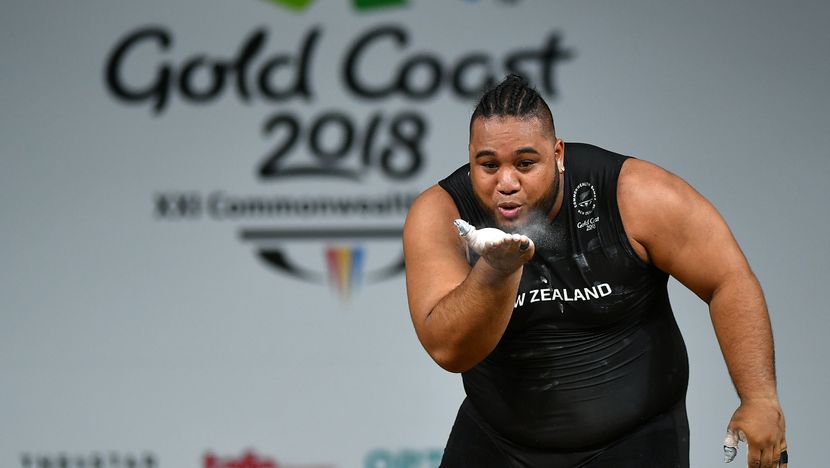
David Liti, New Zealand: Gold Coast 2018
New Zealand weightlifter David Liti won the men’s over-105kg title at Gold Coast 2018 with a Commonwealth Games record total of 403kg.
Samoan rival Lauititi Lui was injured attempting a 228kg clean and jerk and taken from the competition floor in a wheelchair. Lui returned for the medal ceremony to collect silver, where Liti helped him from the stage.
Liti later credited his rival with pushing him towards his record-breaking performance. The then Commonwealth Games Federation President Louise Martin praised his sportsmanship and consideration for a fellow competitor alongside his own achievement. His selection showed how conduct towards a rival could carry as much weight as the result itself.
Feng Tianwei, Singapore: Birmingham 2022
Singapore Table Tennis player Feng Tianwei won all three events she entered at Birmingham 2022 without losing a match.
She led Singapore to the women’s team title, partnered Zeng Jian to doubles gold and then faced the same teammate in the singles final. Feng recovered from three games down to win 4-3 and complete her sweep of the Table Tennis programme.
The three titles took her Commonwealth Games career total to 13 medals, including nine gold, making her the most successful Table Tennis player in Games history. She was also Singapore’s captain and most experienced player at her fourth Commonwealth Games.
Six balances of the same three measures
The David Dixon Award does not just offer one model of an outstanding athlete.
Du Toit changed perceptions of what was possible. Jung dominated the Shooting programme. Smith’s work continued after her own event. Jones delivered a record Welsh medal haul and a historic team result. Liti’s response to an injured rival became as memorable as his victory, while Feng swept the Table Tennis programme at her fourth Games.
The balance has shifted with every recipient, but the measurements for success have remained the same.
At the conclusion of Glasgow 2026, a seventh athlete will join this unique team.
