Women’s Boxing Finds New Ground
When women’s boxing made its Commonwealth Games debut at Glasgow 2014, there were only three weight divisions. Twelve years later, back in the same city, the sport returned with seven, matching the men’s programme for the first time in Games history.
That growth has done far more than balance a schedule. It has opened the Commonwealth Games to boxers and nations the old three-division programme simply had no room for, and Glasgow 2026 delivered a wave of history because of it.
A decade of building towards history
Nowhere was that more visible than in Pakistan’s corner.
The country’s first women’s international boxing team competed at the 2016 South Asian Games, where Rukhsana Parveen and Sofia Javed won bronze. Mehreen Baloch became Pakistan’s first woman to box at a Commonwealth Games at Birmingham 2022.
Four years later, Fatima Zahra arrived in Glasgow as a national champion and a bronze medallist from the 2025 Islamic Solidarity Games. She turned that progress into a podium finish, becoming Pakistan’s first female Commonwealth Games boxing medallist just ten years after the country sent its first women’s team into international competition.
“This is our first step,” Zahra said. “We are developing in boxing, but it’s the sign that we are going in the right direction.”
Divisions that did not exist before
Glasgow’s expanded programme created chances that simply were not available in 2014, when women could compete only at 51kg, 60kg and 75kg.
At 57kg, Fiji’s Jasmine Daunakamakama, the first woman to represent her country internationally in boxing, reached the semi-finals at 21 and became Fiji’s first female Commonwealth Games boxing medallist. She said she hoped her result could open the door for more Fijian women to take up the sport.
In the same division, Lesotho’s Rapelang Maselela won her country’s first women’s boxing medal and became the first woman from Lesotho to win a Commonwealth Games medal in any sport.
At 65kg, Scotland’s Caitlin Rainey took bronze for the host nation, ending a wait that stretched back to Scotland’s first women’s boxing entry in 2018.
Three medals in two categories that did not exist for women a decade earlier. Three nations celebrating a first.
What sustained development looks like
If those stories showed programmes breaking through, India showed what sustained investment can build.
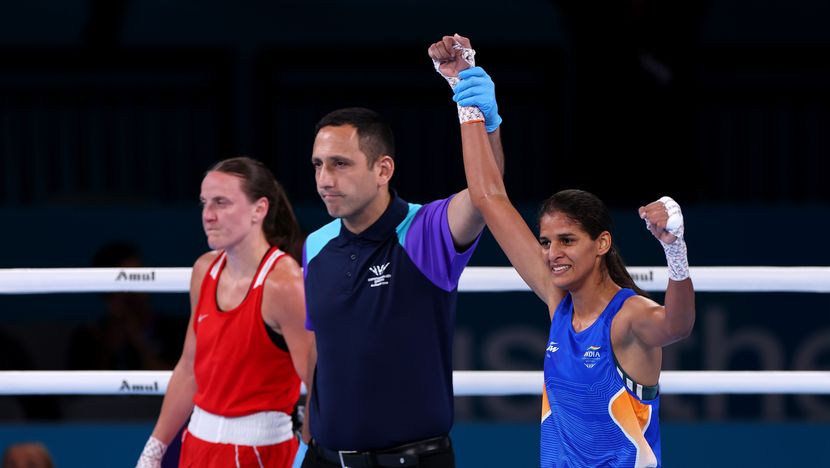
Six Indian women reached finals across the seven divisions, with Preeti Pawar, Jaismine Lamboria, Sakshi Chaudhary, Priya Ghanghas and Arundhati Choudhary winning five titles between 51kg and 70kg. Lovlina Borgohain added silver at 75kg, giving India finalists from the lightest category to the heaviest.
The five women’s titles alone surpassed India’s previous best overall boxing haul of three gold medals at a Commonwealth Games, achieved in 2010, 2018 and 2022.
Mary Kom became India’s first Commonwealth Games women’s boxing champion in 2018, while Nikhat Zareen, Nitu Ghanghas and Lamboria added gold at Birmingham 2022.
Glasgow marked the next stage of that rise, four years before India hosts the Centenary Commonwealth Games in Amdavad.
Building on what Glasgow started
The work now is turning this new opportunity into deeper competition across the sport.
Zambia’s Catherine Mwape, competing at her first Commonwealth Games, took bronze at 54kg. She became the first Zambian woman to win a Commonwealth Games boxing medal and delivered Team Zambia’s first medal of Glasgow 2026.
Tuvalu’s Tarona Taafaki reached the 75kg semi-finals through a bye in a field of just five entrants. Her defeat there still made her Tuvalu’s first Commonwealth Games medallist in any sport.
“I’m very proud and very glad to be able to represent my country on this big stage,” Taafaki said. “Probably 95% of the audience don’t know where my country is, so I feel very privileged to represent Tuvalu.”
Her father and coach, Badi Taafaki, said: “For the people of Tuvalu, this medal means everything. We’re one of the smallest nations in the world, so a medal like this is hugely significant. We have worked so hard to get here. For me as a coach, it’s a stepping stone.”
Both medals mattered enormously to the nations that won them, and both point to where the sport goes next. Glasgow has created more places and more routes to the podium. Building the clubs, coaches, funding and regular competition needed to fill those divisions with deeper fields is the longer project now facing women’s boxing across the Commonwealth.
