
What It Takes to Become a Swimming Nation
By the end of six days at Tollcross, Australia had won 76 medals, 37 of them gold. Its swimmers completed six clean sweeps of the podium, won every relay and surpassed the country's previous record haul from Gold Coast 2018. The rest of the Commonwealth combined won 19 titles.
That dominance was not the work of a few established champions. Australia's 60-strong squad included 18 Para swimmers and drew success from every part of the programme: Olympic champions, experienced medallists, emerging athletes and a coaching system capable of preparing all of them for the same stage.
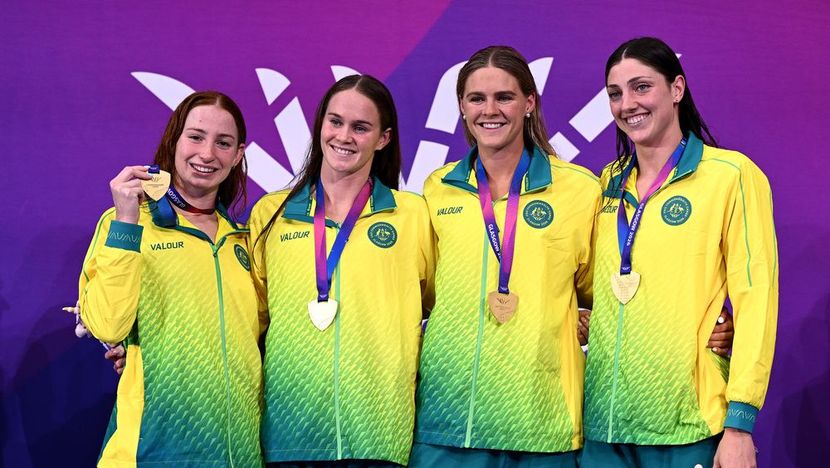
Meg Harris embodied that depth. She finished as the most successful swimmer of the Games with six golds, winning the 50m and 100m freestyle and contributing to four relay victories. Her 100m success led an Australian clean sweep alongside Mollie O'Callaghan and Shayna Jack, two Olympic champions she had never previously beaten in an individual final. Australia used eight swimmers across the heats and final of the women's 4x100m freestyle relay, four of them aged 20 or younger. It could change half the team and still win.
Kai Taylor offered even stronger evidence of that depth, because he was not expected to be one of Australia's leading champions. The 22-year-old started the men's 200m freestyle final in lane one, facing a British contingent filled with Olympic and world-level experience, and had never won an individual senior title. Taylor attacked early and held on as England's James Guy and Wales' Matt Richards closed in the final metres. Both shared silver. Taylor took gold.
The importance of that result went beyond its surprise. Australia did not need the race to favour its most decorated swimmer. It could send out an athlete from the outside lane, against opponents with stronger individual records, and still produce the winner. Australia's advantage ran through the entire structure: facilities, specialist coaches, domestic competition, relay depth and a continuous supply of swimmers capable of replacing one another. Glasgow also showed how differently that structure develops elsewhere.
Carrying success forward
South Africa finished second on the Swimming and Para Swimming medal table with six golds and 22 medals. Bronze in the men's 4x100m medley relay gave Chad le Clos the 21st Commonwealth medal of his career, making him the most decorated athlete in Games history. Alongside him was Pieter Coetze, who swept the 50m, 100m and 200m backstroke titles, the country's greatest Commonwealth swimmer sharing a relay with the athlete now carrying much of its success.
That continuity matters. A strong swimming nation must do more than produce a champion; it must retain the coaching and competitive environment that let another swimmer follow. South Africa arrived in Glasgow with le Clos nearing the end of his Commonwealth career and left with Coetze established as one of the leading swimmers of the next generation.
Jersey was operating on a completely different scale. Before Glasgow, the Island had won only four Commonwealth Games medals and none since Auckland 1990. Filip Nowacki ended that 36-year wait with silver in the men's 100m breaststroke, then became Jersey's first Commonwealth Swimming champion by winning the 200m three days later. His development ran through Tigers Jersey, Millfield and the Loughborough Performance Centre.
Nowacki's success showed what a clear pathway can achieve. The Island has developed a gifted young swimmer and helped him reach one of Britain's leading performance environments. Becoming an impactful Swimming nation will depend on whether that route stays open for those who follow him.
The distance between opportunity and equality
The women's 100m breaststroke SB8 placed two very different Swimming systems on the same podium. England's Brock Whiston won in a Commonwealth Games record, while her 15-year-old team-mate Iona Winnifrith took bronze. Between them finished Husnah Kukundakwe, whose silver was Uganda's first Commonwealth Games Swimming medal, its first Para sport medal and its first medal in any sport outside Athletics or Boxing.
Kukundakwe had already described the conditions behind that breakthrough: her country has only one 50m pool, and she could sometimes use it just once a week. Her silver showed what an individual swimmer can achieve despite limited facilities. However, one breakthrough does not automatically create a system. Its lasting value will depend on whether it leads to better access, stronger coaching and more regular competition for the swimmers behind her.
Nigeria has not yet reached the podium, but 17-year-old Abdul Jabar Adama still moved the country into new territory, winning a swim-off to reach the men's 50m butterfly final and become Nigeria's first Commonwealth Games Swimming finalist.
For Australia, a swimmer winning unexpectedly was evidence of depth. For Uganda and Nigeria, reaching a podium or final for the first time was evidence of possibility.
Glasgow 2026 widened access to the competition, but it could not equalise the conditions that brought each swimmer there. Australia demonstrated what happens when success has been built into a system. South Africa showed how that success can pass between generations. Jersey, Uganda and Nigeria showed where such a process might begin.
A Swimming nation is not created by one champion, one medal or one remarkable week. It is created when the next swimmer has a stronger route than the swimmer who came before.
