
Bowls and the Stage That Defines It
Bowls has world championships, international tours and its own established elite. Yet few events place the sport before a wider audience, or give its leading nations and smallest territories the same visibility, quite like the Commonwealth Games.
At Glasgow 2026, demand from Commonwealth Games Associations was high enough for organisers to add an extra day to the programme, with the men's singles drew alone attracting 26 nations and territories.
For many sports, the Commonwealth Games sits within a wider four-year professional calendar. For Bowls, it remains one of the occasions that defines international success.
That relationship stretches back to Hamilton 1930, when Bowls was one of only six sports on the programme. It has appeared at every edition since, apart from Kingston 1966.
World Bowls chief executive Neil Dalrymple described Glasgow as “a defining and innovative moment for the sport of Bowls globally” in comments to Bowls International.
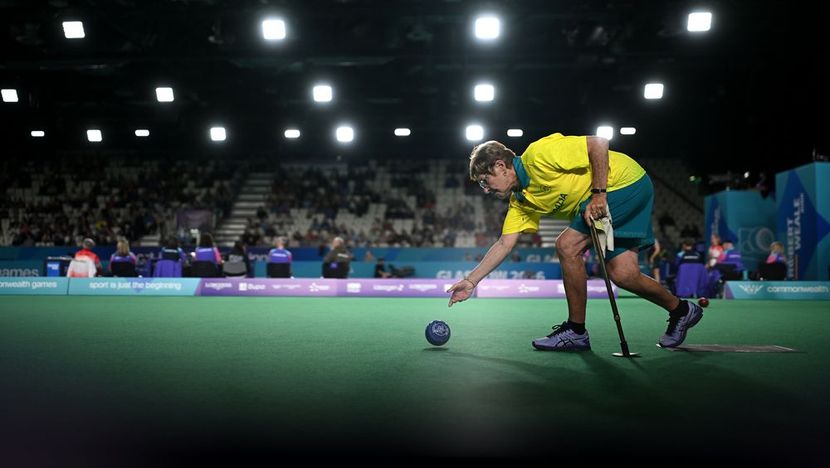
“The indoor venue and the incredible atmosphere created in the stadium has provided an unparalleled stage to showcase our sport to new audiences around the world,” he said.
That stage still brings together very different parts of the Commonwealth. Alongside the traditional powers were smaller members including Niue and Norfolk Island, while eight nations contested the Para Bowls programme.
There is still a performance gap between the established powers and the smaller Bowls nations, but the Games gave them access to the same competition and the same leading players.
That competition has historically been dominated by a familiar group. Before Glasgow, England, Scotland, South Africa, Australia and New Zealand had won 89 of the 111 Commonwealth Bowls gold medals, around 80 per cent of the total.
Malaysia showed in Glasgow that the order was not fixed. Izzat Shameer Dzulkeple reached the men's singles final after ending Aaron Wilson's extraordinary Commonwealth run. The Australian had won gold at Gold Coast 2018 and Birmingham 2022 and had gone 3,027 days without losing a singles match at the Games.
Dzulkeple beat him in a semi-final tiebreak before losing the final to England's Sam Tolchard.
The result mattered because Wilson's record had been built across successive Commonwealth Games. Dzulkeple had not simply beaten one of the world's leading bowlers; he had ended a reign that had become part of the event's history.
Northern Ireland's Adam McKeown and Gary Kelly victory in the men's pairs was their country's first Commonwealth title in the event since 1954.
That 72-year gap shows the weight Commonwealth success carries in Bowls. Generations had come and gone while the same title remained part of the sport's international measure.
The Games can also change how Bowls is seen at home.
At Birmingham 2022, Lovely Choubey, Pinki, Nayanmoni Saikia and Rupa Rani Tirkey won India's first Commonwealth Bowls medal with gold in the women's fours. Their victory pushed a sport with a modest domestic profile into national attention in a way few Bowls competitions could have managed.
Para Bowls extends that reach further. Glasgow staged three Para medal events within the main Bowls programme, with eight nations competing.
Australia's Louise Hoskins made her Commonwealth debut at 76 and won the women's B6-B8 pairs with Serena Bonnell.
“It is incredible. I'm still pinching myself,” Hoskins said afterwards. “I never thought I'd ever get a gold medal at my age.”
Her age made the result remarkable, but the medal was earned on one of Bowls' biggest international stages.
Dalrymple told Bowls International that Para Bowls had “captivated spectators and viewers alike”, adding that there was strong interest from across the Commonwealth in expanding the competition at Amdavad 2030.
Glasgow also changed the way the sport was presented. For the first time at a Commonwealth Games, Bowls was staged indoors on four portable rinks at the SEC Centre.
The setting was new, but the sport still turned on the same things: weight, line, judgement and precision under pressure.
Dalrymple described Glasgow as creating “a template for how international Bowls events can be delivered into the future.”
Nearly a century after Hamilton, that is why the relationship still matters. Bowls gives the Commonwealth Games a sport with deep history, integrated Para competition and a pathway open to an unusually broad range of nations and athletes.
In return, the Games gives Bowls something few other events can match: a stage big enough for its best players, and broad enough to bring the Commonwealth’s smallest nations into the same competition.
