
Closing the Gap in Commonwealth Gymnastics
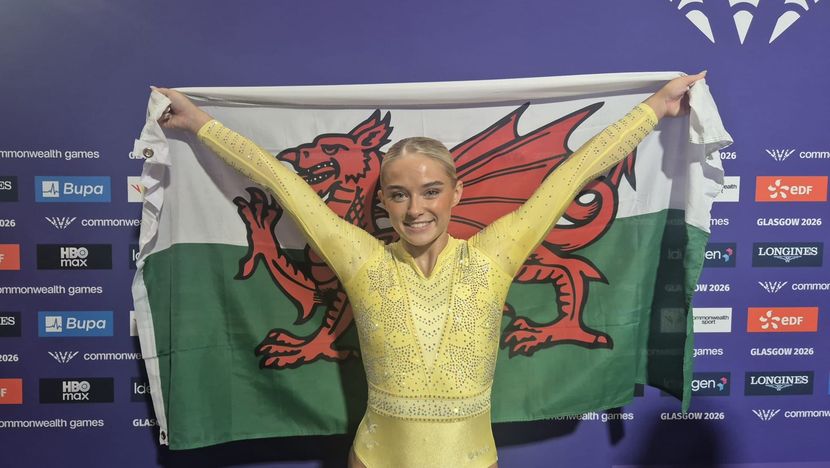
Ruby Evans made Welsh Gymnastics history in Glasgow, becoming her country’s first Commonwealth Games Artistic Gymnastics champion with gold in the floor exercise.
Yet one of the more significant numbers for the Welsh team was not directly attached to a medal at all: 0.900, the margin separating Wales from England and a first women’s team medal.
A squad made up entirely of Commonwealth Games debutants scored 153.400 to finish fourth. However, Evans went on to win gold, Abigail Roper took bronze on vault and Emily Roper bronze on uneven bars. The three individual medals made it Wales’ most successful Commonwealth Artistic Gymnastics performance, but that team result offered evidence that the progress extended beyond just the medallists.
That distinction matters in Artistic Gymnastics. An apparatus medal can be won by one exceptional gymnast, while a team medal demands competitive routines across four apparatus for women and six for men. For decades, that depth has largely belonged to Canada, Australia and England. Canada leads the all-time Commonwealth Artistic Gymnastics standings with 156 medals, including 58 golds, followed by Australia with 151 and England with 116. Their advantage has been built not simply on producing champions, but on repeatedly producing enough high-level gymnasts at the same time to challenge across team, all-around and apparatus competition.
Wales provided the clearest indication in Glasgow that there is more to its current strength than Evans alone. She arrived as a Paris 2024 Olympian, the first Welsh female gymnast to compete at an Olympics in 28 years, the 2025 world floor silver medallist and the 2026 British individual all-around champion, becoming the first Welsh woman to win that title since 1971.
Evans was therefore an obvious individual medal contender, but more revealing was how close an otherwise inexperienced Welsh team came to the bronze medal. Before the Games, she had spoken about that ambition herself: “If a medal comes out of it, a team medal, that would be the absolute dream. If Wales came home with a team medal, that would honestly be incredible.”
Scotland’s men offered another example of how much can sit behind a fourth-place finish. They scored 234.300 in the team competition, only 1.350 points behind bronze medalists, Australia, before Reuben Ward became Scotland’s first men’s Commonwealth all-around champion by beating Canada’s Felix Dolci by 0.200. Ward then added pommel-horse silver, while Cameron Lynn took bronze. His individual success was historic, but Scotland’s team performance proved that it came within the context of a squad capable of pushing one of the traditional powers across six apparatus.
The Scottish women presented a quieter version of the same development. All four members of the team were making their Commonwealth Games debuts and finished sixth, matching the placing at Birmingham 2022, while Crystelle Lake and Ellee Cheetham reached the individual all-around final. There was no medal to mark that transition, but an entirely new group had maintained Scotland’s position during a change of generation.
Australia, Canada and England continued to fill every place on the women’s team podium in Glasgow, while Canada, England and Australia took the men’s medals. They remain the benchmark, and Glasgow did not overturn the established order. However, what the results from Wales and Scotland did show was why medals alone can hide useful signs of progress: inexperienced teams remained competitive, individual champions emerged from programmes with greater depth behind them, and fourth place in both cases was close enough to the podium to really matter.
For Wales and Scotland, that gives Amdavad 2030 a rather different starting point. Glasgow will be remembered for historic individual champions, but the performances around them may prove just as important in judging what comes next.
