One Million Pieces Later: what the King's Baton Relay achieved
When the King's Baton Relay left Buckingham Palace back in March 2025, it began a journey around the Commonwealth with a bold, new purpose: to remove a million pieces of plastic from our waters before the Glasgow 2026 Commonwealth Games began. On World Clean Up Day, we reflect on the legacy of this initiative.
It sounds like a unique job for a baton to carry. But nearly half of our Commonwealth countries are small island nations, where rising seas and disappearing coastlines already cause threat to daily life. The mission to turn the tide of global warming, clean our oceans and waterways and strive towards a more sustainable Games isn't just a nice add on to the Baton Relay, but a commitment to the Commonwealth nations who show up with us every day.
498 days later, two days before the Opening Ceremony, on the banks of the Clyde, we hit our target. One million pieces of plastic no longer in our water.
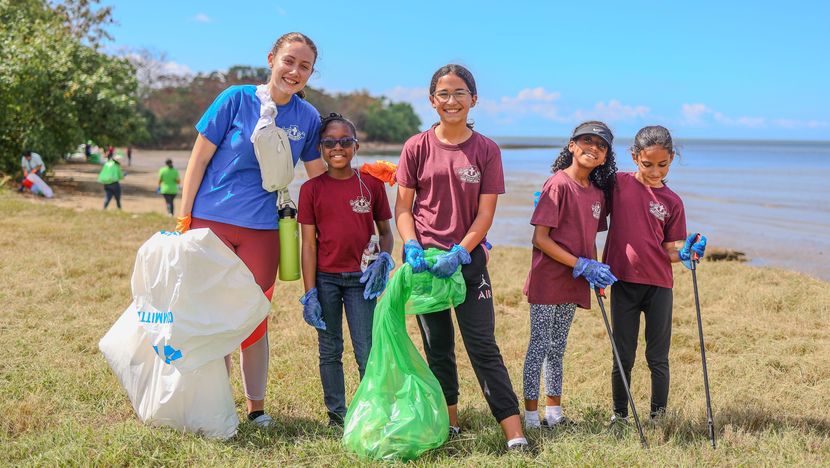
Behind that number, over 15,000 people who turned up to volunteer. More than 50 organisations who said yes. Over 23,000kg of plastic pulled from beaches, rivers and coastlines, one clean up at a time. By canoe in Nigeria. By divers going underwater in Uganda and Barbados. On some of the most remote coastline on earth in Cape York, Australia. None of it would've been possible without our partners, the Royal Commonwealth Society, who charged ahead and made the logistics possible.
But the number was never really the point. It's the impact it had on our communities, and the creativity it inspired from people who were a part of it all.
In Bermuda, an artist is building a whale out of the plastic pulled from local waters. The same waters where, decades ago, someone recorded a whale song nobody could identify until this year. In Antigua and Barbuda, a wall of bottle caps became a mural, alongside a full-scale installation showing communities exactly what a million pieces of plastic actually looks like.
In Kiribati, a clean up turned into an actual income for families. Mozambique's Blue Coins programme is doing the same, paying communities in local currency for what they collect. In Kenya, recovered plastic became a sailing boat. And in Australia, plastic collected from Cape York by Tangaroa Blue volunteers was turned into bag tags, handed straight to their own athletes to carry into the Glasgow 2026 Games.
74 nations. One shared job, and a vision to make our Commonwealth more sustainable.
The Batons descended on Glasgow this summer alongside thousands of athletes, coaches and fans from all over the globe. In the Opening Ceremony, the King's message, placed inside the very first Baton 500 days earlier, was finally read aloud.
After 10 days of athletic prowess, the Games came to an end, and the Batons made their way back to their countries. But the work doesn't stop there. The plastic, the whale, the mural, and the tag hanging off an Australian kit bag are proof that a drop in the ocean, collected by 74 nations, adds up to something bigger.
