How GAPS athletes made their mark in Glasgow
Talent is not the problem. Across the Commonwealth, Para athletes emerge in places where access to a classifier, a specialist coach, suitable equipment or international competition cannot be taken for granted.
GAPS was created to close that distance. At Glasgow 2026, the distance between its athletes and the podium had narrowed. Nine GAPS athletes won ten medals between them: three golds, six silvers and a bronze. Three set world records, while GAPS athletes delivered the first medals of the Games for Ghana, Sri Lanka and Trinidad and Tobago.
Developed by Commonwealth Sport with university and sporting partners, GAPS (Gather, Adjust, Prepare, Sustain) helps Para athletes and coaches overcome barriers to international competition, including access to specialist training, sports science, classification and qualification. The final preparations for Glasgow came in Ayr, where athletes and coaches gathered for a GAPS camp immediately before the Games.
Nigeria provided the clearest early example. Esther Nworgu took gold in the women's lightweight Para powerlifting with a Commonwealth Games record of 123kg; her teammate Esther Oyema took silver. Hours later, Folashade Oluwafemiayo retained her heavyweight title with a world-record 175kg, and Rita Ferdinand added a second Nigerian silver with a world record of her own. Four medals, two events, before the athletics programme had even begun.
Among those who had made the short journey from the GAPS camp in Ayr to Glasgow was Goodness Nwachukwu, the defending champion who had first joined the programme in the build-up to Birmingham 2022. At those Games she broke the F42 discus world record twice on her way to gold.
Her title defence in Glasgow did not start well. Two no-throws left her competition in doubt before a cautious third attempt kept her in it. A fourth-round 33.12m put her into the lead. Then, with her final throw, she sent the discus 39.66m, another F42 world record and a second Commonwealth title. Four years after Birmingham, Nwachukwu was a two-time Commonwealth champion who had set world records at successive Games.
Noemi Alphonse had to adjust to something no training camp could simulate. The Mauritian wheelchair racer was overturned in a collision during the original T54 1500m final; the result was voided following appeals and the race ordered to be run again. Alphonse returned to finish second, then took another silver in the 400m the following day.
She had previously described a GAPS camp as feeling like a small Commonwealth Games, a chance to become familiar with the routines and pressures of an international event. Glasgow gave her circumstances no camp could have written into the schedule, and she still left with two medals.
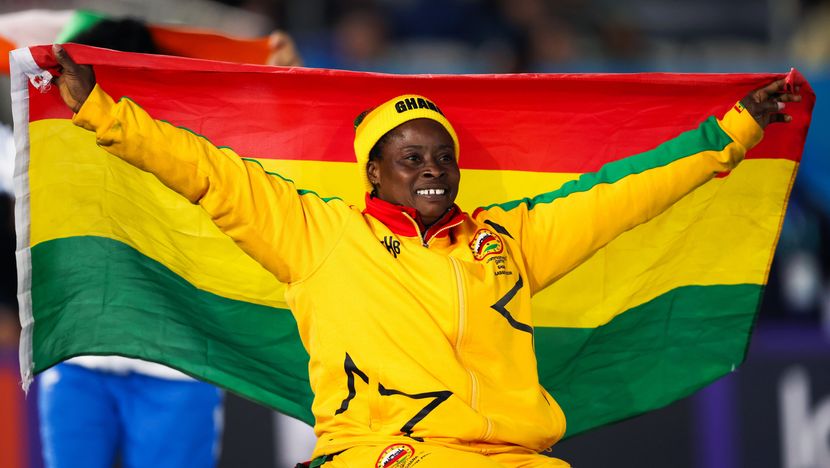
For three nations, a single medal changed the shape of their Games. Zinabu Issah's silver in the women's shot put F57 put Ghana on the board. Palitha Bandara's silver in the men's discus did the same for Sri Lanka, repeating his achievement at Birmingham 2022, where he became his country's first Commonwealth Games medallist in Para sport. In the same Glasgow event, Akeem Stewart's bronze delivered Trinidad and Tobago's first medal of the Games.
The programme's impact reached beyond the podium, too. South African sprinter Masala Makatu had taken up the sport only three years before Glasgow. His first GAPS camp helped him identify his T12 classification and improve his training. By Glasgow, he was making his Commonwealth Games debut alongside his coach Sheryl James, herself a Paralympic and Commonwealth medallist who was still competing.
Their partnership gave "Sustain" a particularly clear meaning in Glasgow. James was pursuing her own career while passing on what she had learned to an athlete near the start of his. That is harder to put a medal count on, but it shows another way experience can move through the programme.
Progress showed up in smaller margins elsewhere. Mauritius's Cedric Bernard improved his national shot put record from 7.16m to 7.53m. Nigeria's Destiny Agbo, who won the first Para medal in Commonwealth Youth Games history at Trinbago 2023, returned to the Commonwealth stage and finished fifth in the discus.
The ten medals belonged to the athletes, whose success was built on years of work with their personal coaches, families and national associations. A development programme cannot take ownership of that work, but Glasgow offered evidence of what can happen when targeted support reaches ability that was already there.
Some athletes left Glasgow with titles and world records. Others left with a national record, a place in a final or their first experience of a Commonwealth Games. For GAPS, that range is the point: helping more athletes reach the Games, and giving some of them the opportunity to reach the podium.
I love you GAPS!
