
When Commonwealth Games results refused to behave
Sometimes sport produces a winner. Sometimes it produces two. And occasionally it produces a result that takes a little longer to explain.
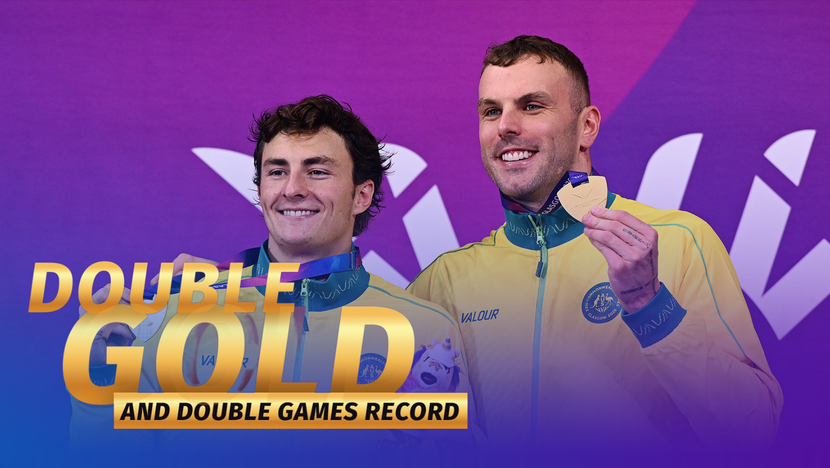
At Glasgow 2026, the men’s 50m butterfly managed several of those things in the space of one competition. Australia’s Kyle Chalmers and Ben Armbruster won their respective semi-finals in exactly the same time, 22.82 seconds, while behind them Wales’ Lewis Fraser and Nigeria’s Abduljabar Adama both clocked 23.52 for the eighth and final qualifying place.
There were only eight lanes, so Fraser and Adama had to return for a head-to-head swim-off to decide who would reach the final. Adama won in 23.32. Then Chalmers and Armbruster did it again, touching together in the final in 22.73 to share gold and the Commonwealth Games record. There was no silver medal, while Cameron McEvoy took bronze.
It was not even the only shared podium in the Tollcross pool. England’s James Guy and Wales’ Matt Richards both recorded 1:45.72 in the men’s 200m freestyle to share silver, while England’s Imogen Clark and Canada’s Sophie Angus shared bronze in the women’s 50m breaststroke after both finished in 30.86. For all the precision of modern timing, a hundredth of a second is not always enough.
The Games have a long history of results that resist a simple reading. At Auckland in 1950, the men’s 110-yard freestyle produced a finishing order that did not quite agree with the stopwatch. Australia’s Gordon Beaumont was officially placed fourth, one place ahead of South Africa’s J.C. Wiid, yet the recorded times showed Wiid had swum one-fifth of a second faster.
Four years later in Vancouver came one of the strangest marathons in Games history. The course measured around 27 miles, longer than the regulation 26 miles and 385 yards, and England’s Jim Peters, the world-record holder, entered the stadium with a huge lead over Scotland’s Joe McGhee. By then, however, Peters had already covered the official marathon distance. He collapsed inside the stadium, repeatedly tried to continue and eventually failed to finish, leaving McGhee to take gold.
Twelve years later, another marathon leader found himself facing a problem that had nothing to do with pace or endurance. Scotland’s Jim Alder was leading at Kingston 1966 when he was directed the wrong way as he approached the stadium and missed the entrance. England’s Bill Adcocks moved ahead while Alder corrected the mistake, but Alder eventually reached the track, regained the lost ground and passed Adcocks on the final lap to win the title.
At Brisbane 1982 came one of the most famous dead heats in Commonwealth Games history. Scotland’s Allan Wells and England’s Mike McFarlane crossed the line together in the men’s 200m final and were both given 20.43 seconds. Officials studied the photo finish and still could not separate them, so both were awarded gold.
Twenty years later, the same problem appeared to have returned in Manchester, but this time the outcome was different. England and Jamaica both recorded 38.62 in the men’s 4x100m relay final at the 2002 Games, yet the photo finish was able to find a difference. England took gold and Jamaica silver. The published times were identical, but the placings were not.
Manchester also produced a genuine shared title in gymnastics, when Cyprus’ Herodotos Giorgallas and Scotland’s Steve Frew could not be separated in the men’s rings and both received gold. Swimming has produced the same sort of complications too. At Gold Coast 2018, Scotland’s Duncan Scott won the men’s 100m freestyle in 48.02, while behind him Chalmers and South Africa’s Chad le Clos both touched in 48.15 and shared silver. Eight years later, Chalmers found himself sharing a medal again, only this time it was gold.
Other unusual results have come not from the stopwatch, but from the shape of the competition itself. In the women’s pole vault at Glasgow 2014, difficult conditions left only four athletes able to clear a height. Australia’s Alana Boyd won gold and Wales’ Sally Peake took silver, while England’s Sally Scott and Canada’s Alysha Newman both cleared 3.80m and shared bronze. Every athlete who successfully cleared a height went home with a medal.
At Glasgow 2026, Para powerlifting produced the opposite problem: a result that looked like a tie until the scoring system went deeper. England’s Mark Swan and Nigeria’s Roland Ezuruike were both shown on 153.9 points in the men’s lightweight final, but the difference only emerged beyond the first decimal place, with Swan ahead when the full calculation was applied. What looked level on the scoreboard was not level enough to share the medal.
And sometimes the strangest result is one in which the contest barely happens at all. At Glasgow 2026, Namibia’s Tryagain Morning Ndevelo advanced by walkover in the boxing when Trinidad and Tobago’s Anthony Joseph missed his call and failed to reach the ring within the permitted time. No punch decided the bout; the clock did.
A marathon has been too long, a race leader has missed the stadium, identical times have produced both shared medals and different placings, and a scoreboard has shown a tie that disappeared when the calculation went one decimal place deeper. At Glasgow 2026, Chalmers and Armbruster added another entry to that history by matching each other in the semi-finals, then coming back and doing it again when gold was at stake.
